Question 1
A tower crane with a 7000 lb, counterweight (A) is used to pick a load with a 15 ft boom extension as shown. The boom has a weight of 1000 lb (CG shown on figure). The tower weighs 3000 lb and the 6 ft x 6 ft footing weighs 20,000 lb. Ignoring wind forces, the maximum load that the crane can lift without overturning is most nearly

Correct Answer : c
Selected Answer : c
Explanation : Concept If crane lifts more weight then, entire crane will overturn about line AB marked in the diagram. Given details Weight of Boom = 1000 lb Weight of Load = W Weight of Tower = 3000 lb Weight of Counter weight = 7000 lb Weight of foundation = 20,000 lb Unit Conversion 1000 lb = 1 kilo lb=1kips Take moment about AB. Moment created by counter weight about AB = 7000 lb * (7+3) ft Moment created by Tower about AB = 3000 lb * 3 ft Moment created by foundation about AB = 20,000 lb * 3 ft Moment created by Boom about AB = 1000 lb * (5-3) ft Moment created by weight about AB = W lb * (10+2) ft Moment created by( Counter weight A + Tower + Foundation )= Moment created by( Load + Boom) 7000 ∗ 10 + 3000 ∗ 3 + 20,000 ∗ 3 ????. ???? = ∗ 12 + 1000 ∗ 2 ????. ???? W = 70000 + 9000 + 60000 − 2000 lb 12 W = 11,416.66lb = 11,416.66 kips = 11.4 kips 1000 Weight that can be lifted without overturning, W = 11 kips W = 11 kips Answer Option c. W = 11.0 kips
Explanation :  ft Moment created by Tower about AB = 3000 lb * 3 ft Moment created by foundation about AB = 20,000 lb * 3 ft Moment created by Boom about AB = 1000 lb * (5-3) ft Moment created by weight about AB = W lb * (10+2) ft Moment created by( Counter weight A + Tower + Foundation )= Moment created by( Load + Boom) 7000 ∗ 10 + 3000 ∗ 3 + 20,000 ∗ 3 ????. ???? = ∗ 12 + 1000 ∗ 2 ????. ???? W = 70000 + 9000 + 60000 − 2000 lb 12 W = 11,416.66lb = 11,416.66 kips = 11.4 kips 1000 Weight that can be lifted without overturning, W = 11 kips W = 11 kips Answer Option c. W = 11.0 kips)
Question 2
What is the yield strength" for most reinforcing bars?
Correct Answer : a
Selected Answer : a
Explanation : Concept Generally, reinforcing steel bars are either carbon-steel (conforming to ASTM A615) or low-alloy steel (conforming to ASTM A706). Reinforcing bars typically come in two primary grades: Grade 40, which has a minimum yield strength of 40,000 psi, and Grade 60, which has a yield strength of 60,000 psi. The metric equivalents for these are Grade 420, which has equivalent yield strength of 420 MPa (megapascals) and Grade 520, which has an equivalent yield strength of 520 MPa.
Explanation :  or low-alloy steel (conforming to ASTM A706). Reinforcing bars typically come in two primary grades: Grade 40, which has a minimum yield strength of 40,000 psi, and Grade 60, which has a yield strength of 60,000 psi. The metric equivalents for these are Grade 420, which has equivalent yield strength of 420 MPa (megapascals) and Grade 520, which has an equivalent yield strength of 520 MPa.)
Question 3
The use of 'Concordant cables in pre stressed continuous beams induces
Correct Answer : b
Selected Answer : b
Explanation : Concept What is concordant cable? A tendon profile in which the eccentricity is proportional at all cross sections to the bending moment caused by any loading on a rigidity supported statically indeterminate structure is a concordant profile. Concordant cable profile is a curb profile that produce no support reaction due to pre - stressing. Answer Option B No initial Support reactions
Explanation : 
Question 4
Carbon brick is made from crushed coke bonded with
Correct Answer : c
Selected Answer : c
Explanation : Concept Definition of carbon brick Brick usually made from crushed coke and bonded with pitch or tar. Answer Option C - Tar
Explanation : 
Question 5
Which one of the following is a typical dry density for normal weight concrete?
Correct Answer : d
Selected Answer : d
Explanation : Concept Dry density of a normal weight concrete is 2250kg/m3 as to compute the dry density of concrete Answer Option D 2250 kg/m3
Explanation : 
Question 6
Sustainable development involves:
Correct Answer : a
Selected Answer : a
Explanation : uploads/Question_Image/a904eb355297f12d125b5bdbeabac8257aced240.png
Explanation : 
Question 7
An activated sludge reactor with a solids retention time of nine days is to achieve nitrification, pH control may be necessary because:
Correct Answer : d
Selected Answer : b
Explanation : CONCEPT Nitrification can create problems in activated sludge operation. A large problem in some plants is a low pH (to as low as pH = 6) caused by extensive nitrification and low wastewater alkalinity. This often causes pin floc and high effluent turbidity. Some plants reduce aeration to reduce nitrification or add soda ash, lime or magnesium hydroxide as a source of alkalinity if this becomes a problem. ANSWER Option d. (Nitrification produces acid) and (The activated sludge process consumes alkalinity)
Explanation :  caused by extensive nitrification and low wastewater alkalinity. This often causes pin floc and high effluent turbidity. Some plants reduce aeration to reduce nitrification or add soda ash, lime or magnesium hydroxide as a source of alkalinity if this becomes a problem. ANSWER Option d. (Nitrification produces acid) and (The activated sludge process consumes alkalinity))
Question 8
If a project has a CPI of 0.95 and an SPI of 1.01, this indicates:
Correct Answer : c
Selected Answer : c
Explanation : CONCEPT How Is the Cost Performance Index Calculated? As the cost variance calculation, the cost performance index requires the input parameters Earned value (EV) Actual cost (AC) The cost performance index is calculated using the following formula: CPI = EV / AC How Is the CPI Interpreted? The CPI is a different way of presenting the cost variance. Being calculated as a ratio rather than an absolute variance, its result indicates the relative scale of deviations which helps asses their criticality. The CPI is also used to project cost incurrence for the future periods of a project, e.g. in the context of re-estimation of budgets. Its results indicate: If CPI = 1, the cost and performance are in line with the plan If CPI < 1, the project has a cost overrun compared to the plan If CPI > 1, the project has incurred less cost than planned What Is the Schedule Performance Index (SPI)? The schedule performance index, too, belongs to the variance analysis techniques. It measures the progress of a project compared to the planned schedule. The SPI can be calculated for a particular period but also cumulative for all a number of periods of a project or the entire project. How Is the Schedule Performance Index Calculated? The schedule performance index is calculated with the same input values as the schedule variance, namely: Earned value (EV) Planned value (PV) The schedule performance index formula is: SPI = EV / PV How to Interpret the SPI? One of the advantages of the SPI is the handy presentation of the progress compared to the plan as well as its use for projections of the future progress. Its value ranges are interpreted as follows: If the SPI = 1, the project is on schedule If the SPI < 1, the project is behind schedule (in other words: the EV is lower than the PV) If the SPI > 1, the project is ahead of schedule ANSWER Option C. the project is progressing faster and costing more than planned
Explanation :  Actual cost (AC) The cost performance index is calculated using the following formula: CPI = EV / AC How Is the CPI Interpreted? The CPI is a different way of presenting the cost variance. Being calculated as a ratio rather than an absolute variance, its result indicates the relative scale of deviations which helps asses their criticality. The CPI is also used to project cost incurrence for the future periods of a project, e.g. in the context of re-estimation of budgets. Its results indicate: If CPI = 1, the cost and performance are in line with the plan If CPI < 1, the project has a cost overrun compared to the plan If CPI > 1, the project has incurred less cost than planned What Is the Schedule Performance Index (SPI)? The schedule performance index, too, belongs to the variance analysis techniques. It measures the progress of a project compared to the planned schedule. The SPI can be calculated for a particular period but also cumulative for all a number of periods of a project or the entire project. How Is the Schedule Performance Index Calculated? The schedule performance index is calculated with the same input values as the schedule variance, namely: Earned value (EV) Planned value (PV) The schedule performance index formula is: SPI = EV / PV How to Interpret the SPI? One of the advantages of the SPI is the handy presentation of the progress compared to the plan as well as its use for projections of the future progress. Its value ranges are interpreted as follows: If the SPI = 1, the project is on schedule If the SPI < 1, the project is behind schedule (in other words: the EV is lower than the PV) If the SPI > 1, the project is ahead of schedule ANSWER Option C. the project is progressing faster and costing more than planned)
Question 9
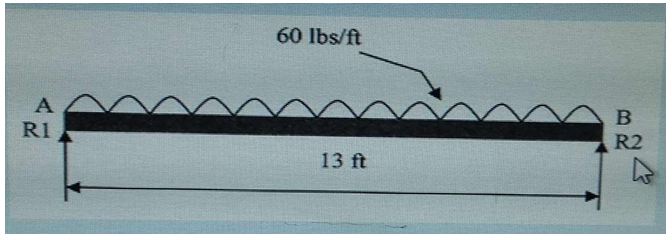
A beam is loaded as shown. Find the maximum shear force of the beam shown
Correct Answer : a
Selected Answer : a
Explanation : SOLUTION Support reactions Solve forces in Y direction. Consider upward force as +ve. ∑ = 0 1 + 2 − (60 ???? ???? ∗ 13) = 0 1 = 2(???????????????????? ????????) 21 − (60 ???? ???? ∗ 13) = 0 21 = (60 ???? ???? ∗ 13 ????) = 780 ???? 2 = 1 = 780 ???? = 390 ???? 2 Consider section xx from left end A. Sign convention to draw SFD Support reactions, R1=R2=390 lb SF at A, x=0 ft = 390 lb SF at B, x=13 ft = -390 lb Maximum SF = 390 lb SFD & BMD ANSWER Option a, SF maximum = 390 lb
Explanation :  = 0 1 = 2(???????????????????? ????????) 21 − (60 ???? ???? ∗ 13) = 0 21 = (60 ???? ???? ∗ 13 ????) = 780 ???? 2 = 1 = 780 ???? = 390 ???? 2 Consider section xx from left end A. Sign convention to draw SFD Support reactions, R1=R2=390 lb SF at A, x=0 ft = 390 lb SF at B, x=13 ft = -390 lb Maximum SF = 390 lb SFD & BMD ANSWER Option a, SF maximum = 390 lb)
Question 10
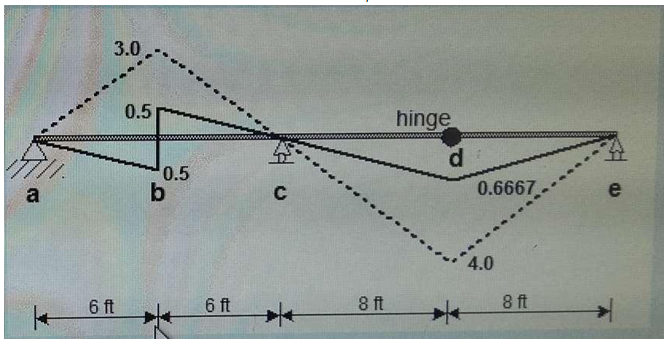
For the Beam shown below, use the Muller-Breslau principle for the influence lines to answer the following The solid lines shown on the beam above, describe the influence line for
Correct Answer : d
Selected Answer : d
Explanation : CONCEPT & SOLUTION To determine the shear at b, remove the shear resistance of the beam at the section by inserting a support that does not resist shear, but maintains axial force and bending moment resistance. Removing the shear resistance will allow the ends on each side of the section to move perpendicular to the beam axis of the structure at this section. Next, apply shear forces on each side of the section to induce a relative displacement between the two ends that will equal unity. Sincethesectioniscutatthemidspan,themagnitudeofeachforceis equalto1/2.(Atb) bb’ = Consider similar triangles Δbb’o & Δdd’o ????????' = ' 6 8 1 2 ' 6 = 8 1 2 ∗ 8 6 = ' = 0.6667 dd’=0.6667 Hence solid line represents shear value at b. ANSWER Option d shear value at b
Explanation :  bb’ = Consider similar triangles Δbb’o & Δdd’o ????????' = ' 6 8 1 2 ' 6 = 8 1 2 ∗ 8 6 = ' = 0.6667 dd’=0.6667 Hence solid line represents shear value at b. ANSWER Option d shear value at b)
Question 11
A secondary effluent that has "pinpoint" floc escaping over the weir indicates
Correct Answer : a
Selected Answer : a
Explanation : CONCEPT Over-aeration can also cause operational problems. Operators love a mixed liquor that settles well. This happens when the microorganisms in the aeration tank excrete a sticky film around their cells as their food gets depleted. Aeration keeps the bugs in suspension, allowing them to collide and ultimately stick together, forming a floc. The floc exhibits a snowball effect: By the time it reaches the secondary clarifier, it is denser than water and settles. Over-aeration can break this floc apart, causing pin floc or small, dispersed floc that does not settle well. Denitrification also cause pin point floc. ANSWER Option A. Over aeration.
Explanation : 
Question 12
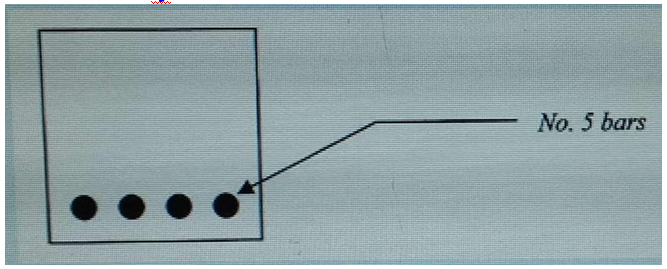
Find the total force in the reinforcements in the beam shown. f, = 60,000 psi. No. 5 bar has a diameter of 5/8 in. , Total force = fy. As
Correct Answer : b
Selected Answer : b
Explanation :
Explanation :
Question 13
The main types of plastic movement occur in concrete are
Correct Answer : c
Selected Answer : c
Explanation : CONCEPT Concrete is made by mixing cement, water and aggregate together to form a paste like slurry. It is molded or placed as desired and left to consolidate and harden. The cement in the concrete forms a chemical reaction with water called hydration. This hydration process is directly responsible for concrete to harden. The properties of concrete in its fresh state directly influence the quality of hardened concrete. Concrete continues to harden/cure over time. Plastic shrinkage cracks: we use the term plastic shrinkage to describe shrinkage which takes whilst concrete is still in a workable/plastic state. The extent of plastic shrinkage are usually restricted by internal friction, formwork and reinforcement. Plastic shrinkage cracks usually form on concrete surfaces exposed to high surface temperatures, strong winds or low humidity. These environmental conditions tends to increase the rate of evaporation of bleed water. Cracks forms when the rate of evaporation is greater than the concrete bleeding rate.Plastic shrinkage cracks has a typical and non continuous crack pattern which are not usually a concern from a structural aspect. Plastic settlement cracking: After concrete has been compacted but before it sets, the solid phase of the mix settles and displaces water to the surface. This process is called bleeding. Plastic settlement cracks form when the settlement of the solid phase is hampered by formwork, reinforcement or void formers. As a result of these restraints the concrete settles away from these obstructions and forms a weakened bond around it, this is undesirable and has to be fixed. Plastic settlement cracks can be prevented by re-vibration or by selecting a more cohesive mix design ANSWER Option C. A and B only Plastic settlement Plastic shrinkage
Explanation : 
Question 14
What is meant by the moral theory utilitarianism?
Correct Answer : b
Selected Answer : b
Explanation : CONCEPT What Is Utilitarianism? Utilitarianism is a theory of morality that advocates actions that foster happiness or pleasure and oppose actions that cause unhappiness or harm. When directed toward making social, economic, or political decisions, a utilitarian philosophy would aim for the betterment of society as a whole. Utilitarianismwouldsaythatanactionisrightifitresultsinthe happinessofthegreatestnumberofpeopleinasocietyoragroup. ANSWER Option B -Construct a global utility - happiness objective function and maximize it
Explanation : 
Question 15
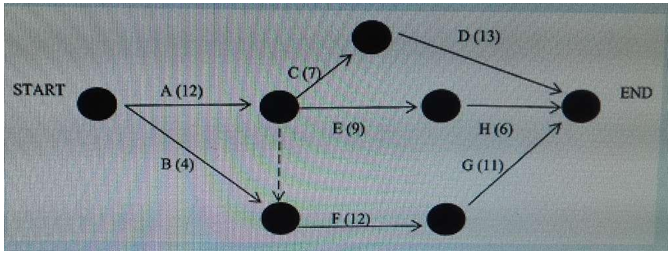
Find the total float of activity D for the project.
Correct Answer : b
Selected Answer : b
Explanation : CONCEPT To calculate total float, subtract the task’s earliest finish (EF) latest finish (LF) LF - EF = total float. Earliest start (ES) date latest start (LS) date, like this LS - ES = total float. EST Calculation - Forward pass Forward Pass to calculate EST and EFT • The EST for the first activity is zero • EFT for an activity is always found by adding its duration to its EST. i.e. EFT = EST + Duration • The EST for all remaining activities is the same as the EFT of its immediate predecessor i.e. EST = EFT of preceding activity • Inthecaseofconvergence,theESTistakenfromthepathhavingthe • The EFT of the last activity is the duration of the project LST Calculation - Reverse pass Reverse Pass to calculate LST and LFT • The LFT for the last activity is the same as its EFT • The LST for an activity is always found by subtracting its duration from its LFT i.e. LST = LFT – Duration • The LFT for all remaining activities is given by the LST of its immediate successor i.e. LFT = LST of the successor activity (moving from start to finish) • Incaseofconvergence,theLFTistakenfromthepathhavingthe SOLUTION EST LST Total float of activity D = LST - EST = 22-19 = 3 ANSWER Option B - Total float of activity D = LST - EST = 22-19 = 3
Explanation :  latest finish (LF) LF - EF = total float. Earliest start (ES) date latest start (LS) date, like this LS - ES = total float. EST Calculation - Forward pass Forward Pass to calculate EST and EFT • The EST for the first activity is zero • EFT for an activity is always found by adding its duration to its EST. i.e. EFT = EST + Duration • The EST for all remaining activities is the same as the EFT of its immediate predecessor i.e. EST = EFT of preceding activity • Inthecaseofconvergence,theESTistakenfromthepathhavingthe • The EFT of the last activity is the duration of the project LST Calculation - Reverse pass Reverse Pass to calculate LST and LFT • The LFT for the last activity is the same as its EFT • The LST for an activity is always found by subtracting its duration from its LFT i.e. LST = LFT – Duration • The LFT for all remaining activities is given by the LST of its immediate successor i.e. LFT = LST of the successor activity (moving from start to finish) • Incaseofconvergence,theLFTistakenfromthepathhavingthe SOLUTION EST LST Total float of activity D = LST - EST = 22-19 = 3 ANSWER Option B - Total float of activity D = LST - EST = 22-19 = 3)
Question 16
The earth pressure that is developed behind a retaining structure depends on the movement of the structure relative to the soil. The active earth pressure is developed when,
Correct Answer : c
Selected Answer : c
Explanation : CONCEPT Earth pressure is the lateral pressure exerted by the soil on a shoring system. It is dependent on the soil structure and the interaction or movement with the retaining system. At rest state: (When the wall is stationary and back fill soil have no tendency to move.) under the rest condition the Retaining wall is stationary therefore lateral stress will be zero. 2. Active state: (when wall moves away from from fill) Activestateisdevelopedwhenthewallmovesawayfromtheback fill.The active earth pressure is less than pressure at rest because the internal resistance is mobilize in the soil of back fill when wall moves away from the back fill. 3. passive pressure: (when wall moves against the fill) In passive state the wall is pushed towards the back fill. The passive earth pressure is greater than earth pressure at rest because shearing resistance is built up between two surface of soil mass. ANSWER Option C. The structure moves away from the soil
Explanation :  under the rest condition the Retaining wall is stationary therefore lateral stress will be zero. 2. Active state: (when wall moves away from from fill) Activestateisdevelopedwhenthewallmovesawayfromtheback fill.The active earth pressure is less than pressure at rest because the internal resistance is mobilize in the soil of back fill when wall moves away from the back fill. 3. passive pressure: (when wall moves against the fill) In passive state the wall is pushed towards the back fill. The passive earth pressure is greater than earth pressure at rest because shearing resistance is built up between two surface of soil mass. ANSWER Option C. The structure moves away from the soil)
Question 17
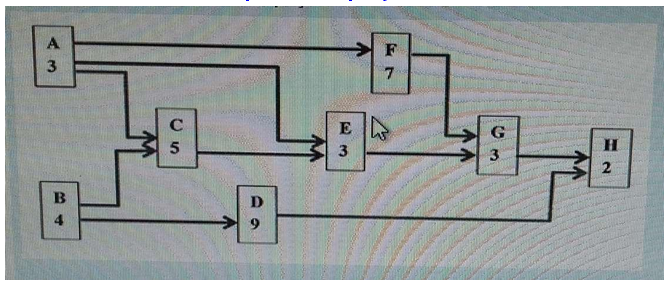
The activity on node network shown below describes a project consisting of 8 tasks A-H. Each node indicates activity minimum time to complete the project is:
Correct Answer : c
Selected Answer : c
Explanation : CONCEPT From activity network representation , minimum time required to finish the project is the maximum of all paths from start to finish. EST Calculation - Forward pass Forward Pass to calculate EST and EFT • The EST for the first activity is zero • EFT for an activity is always found by adding its duration to its EST. i.e. EFT = EST + Duration • The EST for all remaining activities is the same as the EFT of its immediate predecessor i.e. EST = EFT of preceding activity • Inthecaseofconvergence,theESTistakenfromthepathhavingthe • The EFT of the last activity is the duration of the project Minimum time required to complete the project = Critical path duration Longest path in a project network It has the maximum suration It decides the project completion time Path B-C-E-G-H=17 WEEKS ANSWER Option c. 17 weeks
Explanation : 
Question 18
Inspections are also called:
Correct Answer : d
Selected Answer : d
Explanation : CONCEPT An inspection is the examination of a work product he results of a single activity can be inspected, or the final product itself can be inspected. Inspections might be called reviews, peer reviews, audits or walkthroughs. ANSWER Option d. All answer are true
Explanation : 
Question 19
The forward pass in project network calculations determines the:
Correct Answer : d
Selected Answer : d
Explanation : uploads/Question_Image/857c7af1d886191b4d53ae1beb5acb05f6488391.png
Explanation : 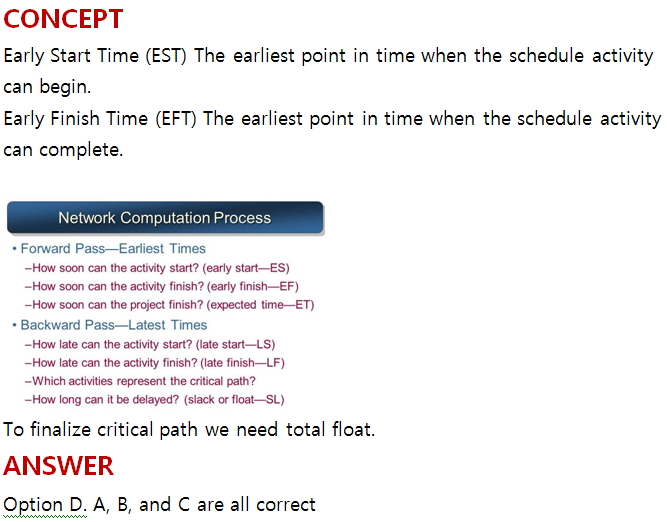
Question 20
What loads are considered as construction loads?
Correct Answer : b
Selected Answer : b
Explanation : CONCEPT Construction Loads as defined by ASCE 37-02 are those loads imposed on a partially completed or temporary structure during and as a result of the construction process. Construction loads include, but are not limited to, materials, personnel, and equipment imposed on the temporary or permanent structure during the construction process. ANSWER Option B- Wind load, dead weight, live load from construction workers, Load due to wet concrete
Explanation : 
Question 21
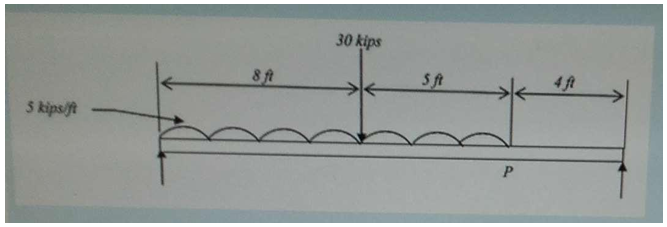
Find the maximum bending moment of a beam loaded with a uniform load of 5 kips/ft, and a concentrated load of 30 kips
Correct Answer : a
Selected Answer : a
Explanation : SOLUTION Find support reactions Solve forces in Y direction Consider upward force as +ve ∑ = 0: + − (13 ∗ 5) − 30 = 0 ∑ = 0: + = (13 ∗ 5) + 30 = 95 + = 95 Take moment about left support,A ∑ = 0 Consider clockwise moment as +ve − ∗ 17 + 30 ∗ 8 + 5 ∗ 13 ∗ 7.5 = 0 ∗ 17 = 30 ∗ 8 + 5 ∗ 13 ∗ 7.5 = 30 ∗ 8 + 5 ∗ 13 ∗ 6.5 17 = 42.79 + = 95 = 95 − = 95 − 38.97 = 56.03 = 56.03 = 38.97 Draw BMD Consider section xx from left support A. Sign convention as shown below, BM at A(left end), x=0 ft = 0 kip.ft BM at point load, x=8 ft = (56.03*8)-(5*8*4)=288.24 kip.ft BM at end of udl, x = 13 ft = (56.03*13)-(5*13*6.5)-(30*5)=155.89 kip.ft BM at B(Right end), x=13ft = 0 kip. Ft Maximum bending moment, BMmax = 288.24 kip.ft SFD & BMD of the beam ANSWER Option a. 288 kip.ft
Explanation :  − 30 = 0 ∑ = 0: + = (13 ∗ 5) + 30 = 95 + = 95 Take moment about left support,A ∑ = 0 Consider clockwise moment as +ve − ∗ 17 + 30 ∗ 8 + 5 ∗ 13 ∗ 7.5 = 0 ∗ 17 = 30 ∗ 8 + 5 ∗ 13 ∗ 7.5 = 30 ∗ 8 + 5 ∗ 13 ∗ 6.5 17 = 42.79 + = 95 = 95 − = 95 − 38.97 = 56.03 = 56.03 = 38.97 Draw BMD Consider section xx from left support A. Sign convention as shown below, BM at A(left end), x=0 ft = 0 kip.ft BM at point load, x=8 ft = (56.03*8)-(5*8*4)=288.24 kip.ft BM at end of udl, x = 13 ft = (56.03*13)-(5*13*6.5)-(30*5)=155.89 kip.ft BM at B(Right end), x=13ft = 0 kip. Ft Maximum bending moment, BMmax = 288.24 kip.ft SFD & BMD of the beam ANSWER Option a. 288 kip.ft)
Question 22
In order to provide the proper geometric standard for each roadway/ highway component, what is it that needs to be established first?
Correct Answer : a
Selected Answer : d
Explanation : The correct answer is: A. Functional Classification Functional classification is the first thing that needs to be established. It defines the role of the roadway in the overall transportation network (e.g., arterial, collector, local road) and guides decisions regarding geometric standards, such as lane width, design speed, and access control.
Explanation :  and guides decisions regarding geometric standards, such as lane width, design speed, and access control.)
Question 23
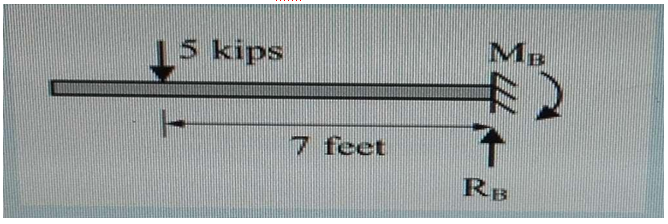
Calculate the reaction Rb.
Correct Answer : c
Selected Answer : c
Explanation : uploads/Question_Image/e5f8ff283b1172f0864d3fa8250dabdc2840ae5b.png
Explanation : 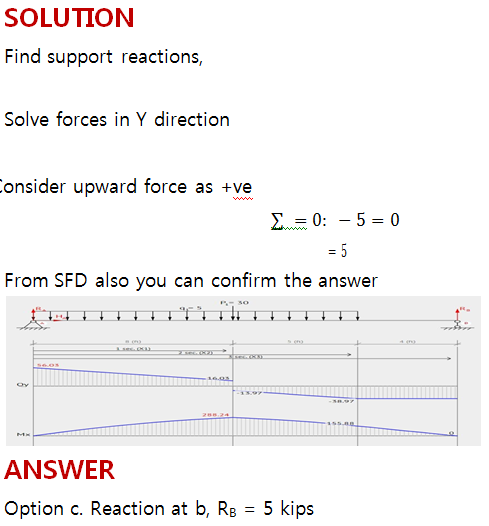
Question 24
A building with a gabled roof will experience pressure on its leeward slope which is
Correct Answer : b
Selected Answer : b
Explanation : CONCEPT A building with gabled roof will always experience negative pressure on leeward side. ANSWER Option B - Always negative
Explanation : 
Question 25
The main activity in project scope definition is to
Correct Answer : d
Selected Answer : d
Explanation : CONCEPT Product Scope: Product is an output of the project and features, specifications, details about the product are described in the product scope. And therefore, since the product is a project deliverable, product scope will be included in the Project Scope Statement as well. Project Scope Statement is the primary output of the Define Scope process. This process draws the boundaries of the project, outlines the work that will be delivered throughout the project and defines the major deliverables of the project. We can say that the main purpose of the Define Scope process is finalizing the project scope, after reviewing and evaluating all customer requirements collected during Collect Requirements process. Scope baseline is a project baseline and the Scope Statement, Work Breakdown Structure, and Work Breakdown Structure Dictionary together, constitutes the Scope baseline. The work breakdown structure shows the hierarchy of project deliverables in a structured manner. Work Breakdown Structure Dictionary provides detailed information about each item in the Work Breakdown Structure. ANSWER Option E -define the work breakdown structure
Explanation : 
Question 26
soil samples extracted from the Standard Penetration Test (SPT) can be used in
Correct Answer : d
Selected Answer : d
Explanation : ANSWER Samples soil collected can be used in Liquid limit test, sieve analysis & Hydrometer. Option D.All of the above
Explanation :