Question 1
If an object is floating on a liquid surface, the vertical force acting on it due to liquid
pressure is called:

Correct Answer : c
Selected Answer :
Explanation : The vertical force acting on an object floating on a liquid surface due to liquid pressure is called buoyancy force. Therefore, the correct answer is buoyancy force.
Explanation : 
Question 2
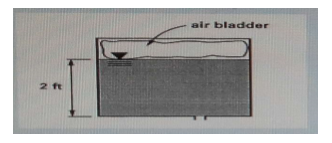
The air in the bladder-type expansion tank shown has been pressurized to 15 psig.
The total pressure at the bottom exit of the tank is most nearly
Correct Answer : b
Selected Answer :
Explanation : uploads/Question_Image/1867f17d196b0d261f138a88d5cfd45ea99034e9.jpeg
Explanation : 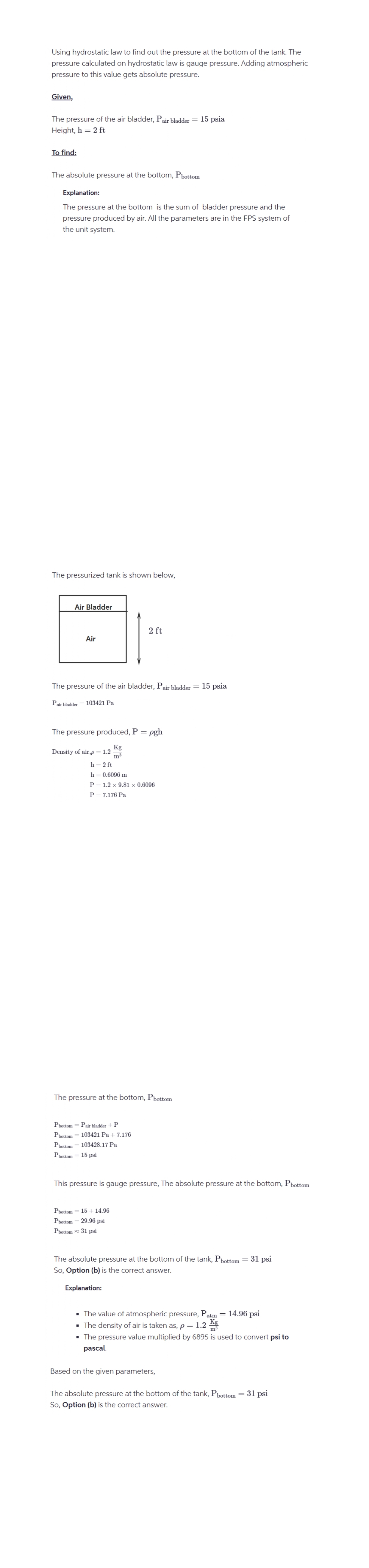
Question 3
Design experiments specify that a cell phone's plastic shell must survive a fall onto
concrete. Static compressions tests indicate shell fracture at 1250 lbf and 0.005 in.
deflection. If a factor of safety of 6 is used, what is most nearly the maximum
allowable phone weight?
Correct Answer : b
Selected Answer :
Explanation :
Explanation :
Question 4
Flow through a sudden contraction in a pipe
Correct Answer : b
Selected Answer :
Explanation : Flow through a sudden contraction in a pipe can result in significant energy loss. Therefore, the correct statement among the options is: "Results in significant energy loss."
Explanation : 
Question 5
How often shall a test frequency be done on visible appliance as per NFPA 722
Correct Answer : a
Selected Answer :
Explanation : According to NFPA 72, visible fire alarm appliances (such as smoke detectors, heat detectors, and notification appliances) are typically tested annually for proper operation, while their visual inspection is required semi‑annually.
Explanation :  are typically tested annually for proper operation, while their visual inspection is required semi‑annually.)
Question 6
A Project Manager is supervising construction of a medium-sized part assembly
workshop. He submits a report to h foundation and framing work based on the soil
analysis and loading specifications for the building. The total came t whatever it
takes to get that figure down to $20,000. He should:
Correct Answer : d
Selected Answer :
Explanation : Answer: The correct option is: D. both B & C are appropriate Explanation: A project manager is tasked with reducing the cost of the foundation and framing work from $25,000 to $20,000 for a part assembly workshop construction. Explanation: Here's why both options B and C are appropriate: B. Redo the soil tests to try to get better figures: Redoing soil tests is essential to ensure that the soil analysis and loading specifications are accurate. If the initial soil analysis was inaccurate, it could lead to unnecessary foundation costs. By conducting new soil tests and obtaining more accurate data, the project manager can potentially revise the foundation design, which may reduce costs.' Explanation: C. Try to revise the framing design to minimize material costs while meeting the design specifications: Revising the framing design to optimize material costs is another valid approach. The project manager can work with engineers and architects to explore alternative framing designs that maintain structural integrity while using less expensive materials or reducing the amount of materials needed. This can help achieve cost savings in the framing portion of the project. By combining both options B and C, the project manager can explore multiple avenues to achieve the boss's goal of reducing the cost of the foundation and framing work to $20,000.
Explanation : 
Question 7
The net entropy change in the universe during any real process
Correct Answer : b
Selected Answer :
Explanation : The net entropy change in the universe during any real process is always positive. This statement is in accordance with the second law of thermodynamics, which states that the entropy of an isolated system tends to increase over time. Therefore, the correct statement is: "Is positive."
Explanation : 
Question 8
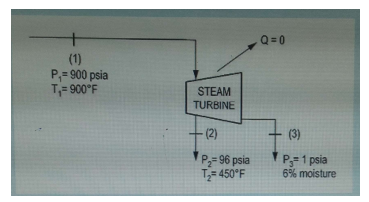
The turbine efficiency from State 1 to State 2 is:
Correct Answer : b
Selected Answer :
Explanation : uploads/Question_Image/578f780593ed8502154bfa8f82764b911299ae7e.jpeg
Explanation : 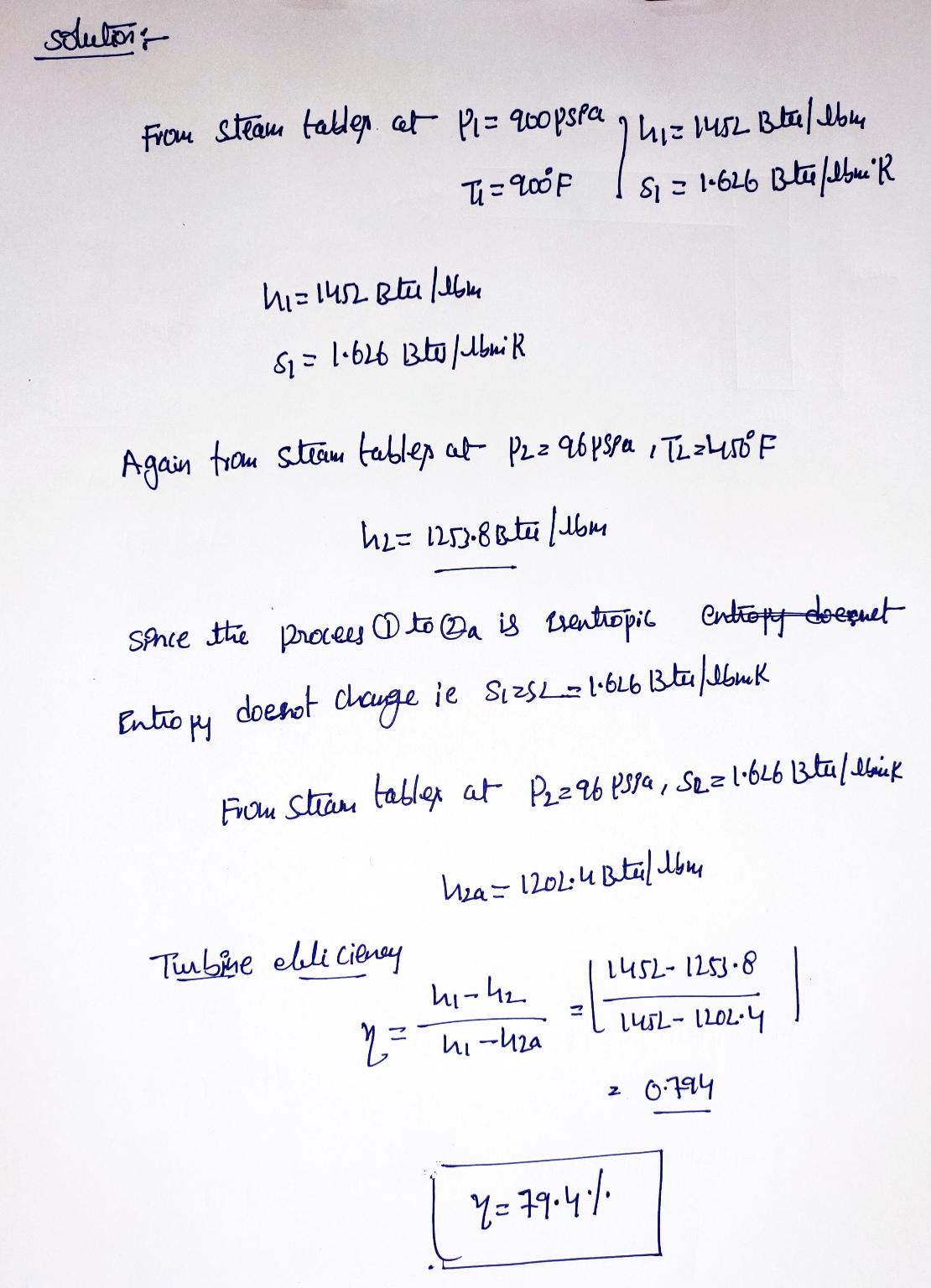
Question 9
An isolated system is one which
Correct Answer : c
Selected Answer :
Explanation : An isolated system is a thermodynamic system where neither mass nor energy crosses the system's boundary. This means that an isolated system has a fixed mass and fixed energy. In an isolated system, there is no work or heat transfer because both work transfer and heat transfer are energy transfers. Energy for an isolated system is always conserved. An isolated system differs from a closed system by the transfer of energy. Closed systems are only closed to matter, energy can be exchanged across the system's boundaries. A manual ice cream freezer is an example of an isolated system.
Explanation : 
Question 10
What do you call the equipment, materials, or services included in a list published
by an organization that is accept concern with evaluation of products or services
that maintains periodic inspection of production of listed equipment services, and
whose listing states that either the equipment, material, or service meets appropriate
designated stan suitable for a specified purpose?
Correct Answer : a
Selected Answer :
Explanation : According to NFPA 731 and NFPA 70, equipment, materials, or services that are included in a list published by an organization are considered "listed". The organization must be acceptable to the authority having jurisdiction and concerned with evaluating products or services. The organization must also maintain periodic inspection of production or periodic evaluation of services.
Explanation : 
Question 11
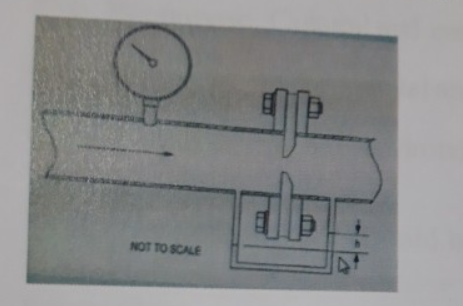
The flow of water in a 10-inch schedule 40 pipe is to be metered. The temperature of the water is 100 degree F and the static pressure up stream of the meter is 20 psig. The density of the water is 62 lbm/ft2. Assume the flow meter is a square edged orifice with a diameter ratio of 0.5 when the flow rate is 1200 gpm and the flow coefficient is 0.5 the ppressure drop across the orifice (lbf/in2) is pipe ID =10.02 in .
Correct Answer : a
Selected Answer :
Explanation : uploads/Question_Image/cddde9b593e38109e3effd945c402fc8864fcb60.jpeg
Explanation : 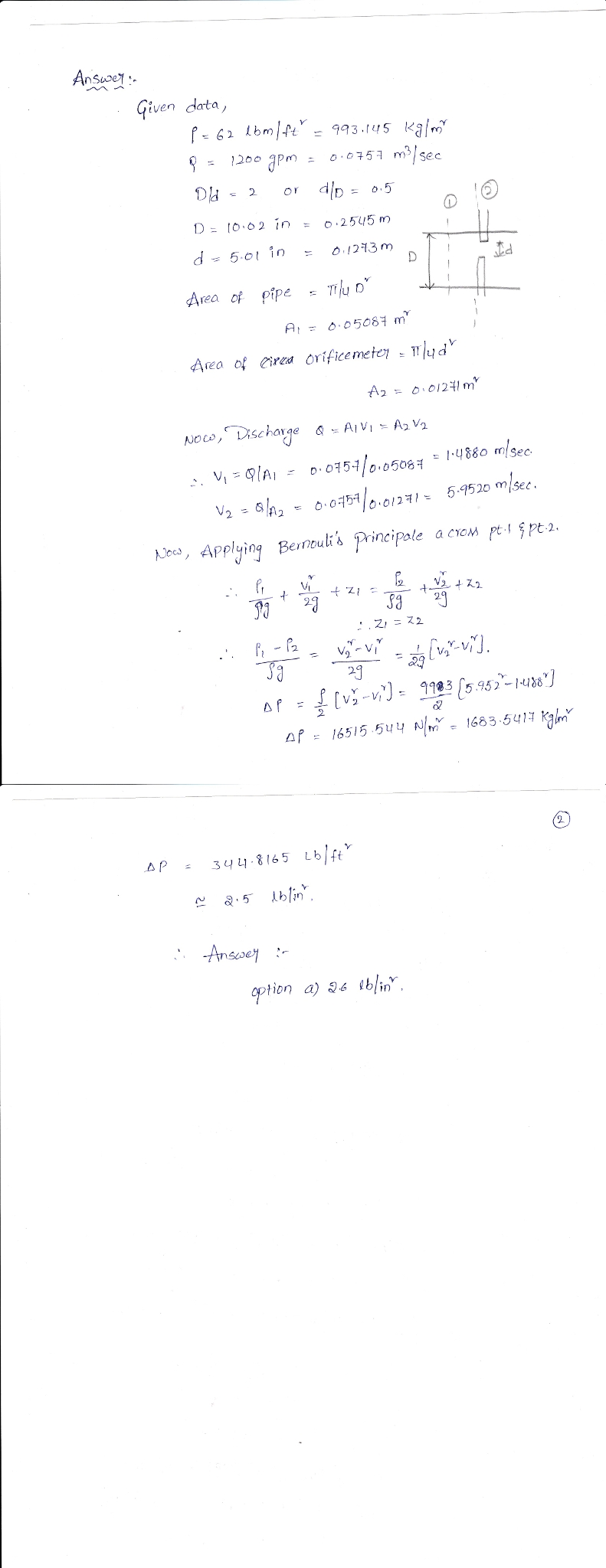
Question 12
In an isothermal atmosphere, the pressure
Correct Answer : d
Selected Answer :
Explanation : In an isothermal atmosphere, the temperature remains constant with elevation. In such a case, the pressure decreases exponentially with elevation. Therefore, the correct statement is: "Decreases exponentially with elevation."
Explanation : 
Question 13
Specific speed of a turbomachine
Correct Answer : b
Selected Answer :
Explanation : The specific speed of a turbomachine relates to the shape rather than the size of the machine. The specific speed of a turbine is the speed of a turbine that is similar in shape and geometric dimensions to the actual turbine. It is also of a size that would develop unit power (1 kilowatt) when working under the unit head at its maximum efficiency. The specific speed of a turbine is given by the manufacturer and will always refer to the point of maximum efficiency. The unit of specific speed is given as rotation per minute or abbreviated as RPM. The specific speed is useful to compare the performance of the various type of turbines.
Explanation :  when working under the unit head at its maximum efficiency. The specific speed of a turbine is given by the manufacturer and will always refer to the point of maximum efficiency. The unit of specific speed is given as rotation per minute or abbreviated as RPM. The specific speed is useful to compare the performance of the various type of turbines.)
Question 14
How often shall a visual inspection be done on visible appliance as per NFPA 72?
Correct Answer : b
Selected Answer :
Explanation : Semi-annually. NFPA 72 specifies visual inspections of visible appliances (notification devices like strobes) every six months to check for damage, cleanliness, and proper condition. This aligns for most fire alarm components, distinguishing from annual functional tests.
Explanation :  every six months to check for damage, cleanliness, and proper condition. This aligns for most fire alarm components, distinguishing from annual functional tests.)
Question 15
What shall be the flash rate requirement of a visible signaling device?
Correct Answer : b
Selected Answer :
Explanation : The flash rate shall not exceed two flashes per second (2 Hz) nor be less than one flash every second (1 Hz) throughout the listed voltage range of the appliance.
Explanation :  nor be less than one flash every second (1 Hz) throughout the listed voltage range of the appliance.)
Question 16
The final step in the definition of a Work Breakdown Structure is to:
Correct Answer : a
Selected Answer :
Explanation : a. assign codes for each activity of the work package Explanation:- The final step is to document the structure created of the Work Breakdown Structure. In this course, each subtask also receives a code - the number of work packages. This ensures that there is a fixed place in the structure of the division of labor and that the work package is clearly defined.
Explanation : 
Question 17
Which of the following statement(s) is true?
Correct Answer : d
Selected Answer :
Explanation :
Explanation :
Question 18
The main object of Morse test is to find out
Correct Answer : c
Selected Answer :
Explanation : The correct answer is Frictional power of a multi-cylinder engine Understanding the Morse Test and its Purpose The Morse test is a method used to determine the indicated power and frictional power of a multi-cylinder engine. It is particularly useful for engines with multiple cylinders, as it is difficult to directly measure the indicated power of individual cylinders while the engine is running normally. How the Morse Test Works The principle behind the Morse test involves sequentially cutting off the ignition (for petrol engines) or fuel supply (for diesel engines) to each cylinder while keeping the engine running at a constant speed. When one cylinder is cut off, the power output of the engine decreases. This decrease in power is measured by a dynamometer. The reduction in brake power is assumed to be equal to the indicated power of the cylinder that was cut off. Let's consider an engine with 'n' cylinders. First, the brake power (BP) of the engine is measured with all cylinders firing. Let this be BPtotal. Then, cylinder 1 is cut off, and the brake power is measured. Let this be BP1. The indicated power of cylinder 1 (IP1) is calculated as IP1 = BPtotal - BP1. This process is repeated for each cylinder (cylinder 2, cylinder 3, ..., cylinder n). The indicated power for each cylinder (IP2, IP3, ..., IPn) is found by subtracting the brake power with that specific cylinder cut off from the total brake power. IPi = BPtotal - BPi (where BPi is the brake power when cylinder 'i' is cut off). Calculating Total Indicated Power and Frictional Power The total indicated power (IPtotal) of the engine is the sum of the indicated powers of all individual cylinders: IP total = IP 1 + IP 2 + ⋯ + IP n IP total =IP 1 +IP 2 +⋯+IP n The frictional power (FP) of the engine is the difference between the total indicated power and the total brake power: FP = IP total − BP total FP=IP total −BP total Analyzing the Options Let's look at the given options: Option 1: Performance of a single cylinder diesel engine. The Morse test is primarily for multi-cylinder engines, not single-cylinder ones. Performance is a broad term, and while indicated power and frictional power are aspects of performance, the test is not typically applied to single cylinders this way. Option 2: Indicated power of a single cylinder diesel engine. As mentioned, the test is for multi-cylinder engines. While it allows calculation of individual cylinder indicated power within a multi-cylinder setup, it's not the primary object for a standalone single-cylinder engine. Other methods like indicator diagrams are more direct for single cylinders. Option 3: Frictional power of a multi-cylinder engine. As explained, the Morse test allows the calculation of the total indicated power and the total brake power, from which the frictional power of the entire multi-cylinder engine can be determined. This is a key output of the test. Option 4: None. This is incorrect as Option 3 accurately describes a main objective of the test. Therefore, the main object of the Morse test is to find out the frictional power of a multi-cylinder engine (in addition to the indicated power).
Explanation :  or fuel supply (for diesel engines) to each cylinder while keeping the engine running at a constant speed. When one cylinder is cut off, the power output of the engine decreases. This decrease in power is measured by a dynamometer. The reduction in brake power is assumed to be equal to the indicated power of the cylinder that was cut off. Let's consider an engine with 'n' cylinders. First, the brake power (BP) of the engine is measured with all cylinders firing. Let this be BPtotal. Then, cylinder 1 is cut off, and the brake power is measured. Let this be BP1. The indicated power of cylinder 1 (IP1) is calculated as IP1 = BPtotal - BP1. This process is repeated for each cylinder (cylinder 2, cylinder 3, ..., cylinder n). The indicated power for each cylinder (IP2, IP3, ..., IPn) is found by subtracting the brake power with that specific cylinder cut off from the total brake power. IPi = BPtotal - BPi (where BPi is the brake power when cylinder 'i' is cut off). Calculating Total Indicated Power and Frictional Power The total indicated power (IPtotal) of the engine is the sum of the indicated powers of all individual cylinders: IP total = IP 1 + IP 2 + ⋯ + IP n IP total =IP 1 +IP 2 +⋯+IP n The frictional power (FP) of the engine is the difference between the total indicated power and the total brake power: FP = IP total − BP total FP=IP total −BP total Analyzing the Options Let's look at the given options: Option 1: Performance of a single cylinder diesel engine. The Morse test is primarily for multi-cylinder engines, not single-cylinder ones. Performance is a broad term, and while indicated power and frictional power are aspects of performance, the test is not typically applied to single cylinders this way. Option 2: Indicated power of a single cylinder diesel engine. As mentioned, the test is for multi-cylinder engines. While it allows calculation of individual cylinder indicated power within a multi-cylinder setup, it's not the primary object for a standalone single-cylinder engine. Other methods like indicator diagrams are more direct for single cylinders. Option 3: Frictional power of a multi-cylinder engine. As explained, the Morse test allows the calculation of the total indicated power and the total brake power, from which the frictional power of the entire multi-cylinder engine can be determined. This is a key output of the test. Option 4: None. This is incorrect as Option 3 accurately describes a main objective of the test. Therefore, the main object of the Morse test is to find out the frictional power of a multi-cylinder engine (in addition to the indicated power).)
Question 19
A heating system requires a hot-water heating coil to heat 10,000 cfm of air to
160°F db. The air consists of 2,000 cfm of ou 70°F db. Hot water at 180°F is available. With a 40°F temperature drop, the flow (gpm) of hot water required is
most nearly
Correct Answer : a
Selected Answer :
Explanation : uploads/Question_Image/262c7f414d91b0610e60f16d0c97a3063ecb74d0.png
Explanation : 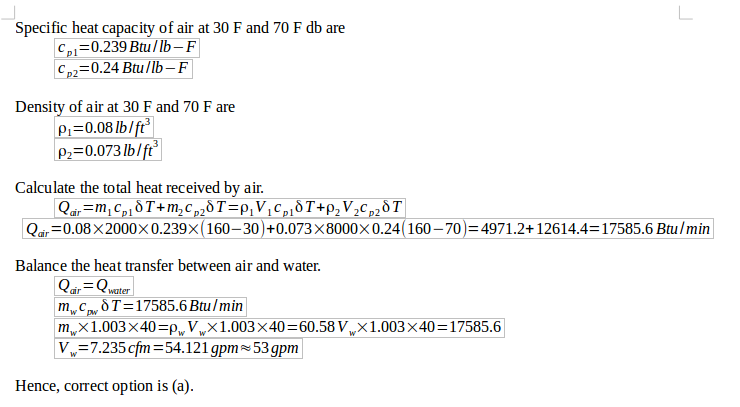
Question 20
The main activity in project scope definition is to:
Correct Answer : d
Selected Answer :
Explanation : Project scope is the part of project planning that involves determining and documenting a list of specific project goals, deliverables, tasks, costs and deadlines. ... The scope statement also provides the team with guidelines for making decisions about change requests during the project.
Explanation : 
Question 21
.To determine the flow rate using a square-edged orifice, the pressure must be measured upstream of the orifice and
Correct Answer : c
Selected Answer :
Explanation : To determine the flow rate using a square-edged orifice, the pressure must be measured upstream of the orifice and just downstream of the orifice at the vena contracta
Explanation : 
Question 22
Software programming flow
Correct Answer : a
Selected Answer :
Explanation : The Plan-Do-Check-Act (PDCA) cycle is a management methodology that can be used in software development to improve the quality of software products and processes. The four steps of the PDCA cycle are: Plan: Recognize an opportunity and plan a change Do: Test the change, or carry out a small-scale study Check: Review the test, analyze the results, and identify what you've learned Act: Take action based on what you learned in the study step The PDCA cycle is also known as the Deming cycle. It's an iterative four-step management method that flows clockwise through four steps. Since the cycle is a cycle, you can start over from the beginning again as soon as you reach the end.
Explanation :  cycle is a management methodology that can be used in software development to improve the quality of software products and processes. The four steps of the PDCA cycle are: Plan: Recognize an opportunity and plan a change Do: Test the change, or carry out a small-scale study Check: Review the test, analyze the results, and identify what you've learned Act: Take action based on what you learned in the study step The PDCA cycle is also known as the Deming cycle. It's an iterative four-step management method that flows clockwise through four steps. Since the cycle is a cycle, you can start over from the beginning again as soon as you reach the end.)
Question 23
The change in thermodynamic availability is equal to:
Correct Answer : d
Selected Answer :
Explanation : The actual work output of a system is different from the maximum possible work output due to the irreversibility present in the system. The difference between the reversible work output and actual work output act as a measure of irreversibility present in the system. Therefore, the options (c) and (e) are wrong. Thus the correct option is option d
Explanation :  and (e) are wrong. Thus the correct option is option d)
Question 24
In the design of a refrigeration system, care should be taken to pitch the compressordischarge piping downward from the compressor, in order to:
Correct Answer : d
Selected Answer :
Explanation : The correct option is: Prevent oil from draining back into the compressor when it is not operating. Explanation: In refrigeration systems, it's crucial to prevent oil from draining back into the compressor when it's not operating because oil can damage the compressor and reduce its efficiency. By having the discharge piping pitched downwards from the compressor, any oil that accumulates in the piping can flow back into the compressor when it starts up, ensuring proper lubrication and preventing damage. Therefore, The correct option is: Prevent oil from draining back into the compressor when it is not operating.
Explanation : 
Question 25
The velocity head in a section of a pipe is given by :
Correct Answer : a
Selected Answer : b
Explanation : EGL= ENERGY GRADE LINE HGL= HYDRAULIC GRADE LINE LET v= velocity at section g= acceleration due to gravity We know that, Velocity head = square(v)/2g Explanationfor step 1 Hydraulic Grade Line is a line joining all the liquid levels directed by piezometers connected to the pipeline throughout. Energy grade line derives the variation of the total head. EGL = v²/2g + P/y + elevation P = pressure y= fluid density The Hydraulic Grade Line is a form of the sum of two of the steps of the Bernoulli theorem: Fluid Head = The Flow energy + The Potential energy. HGL = P/y + elevation. So Substracting HGL from EGL we will get velocity head. Answer -A) Difference between EGL ; HGL at the section
Explanation : /2g Explanationfor step 1 Hydraulic Grade Line is a line joining all the liquid levels directed by piezometers connected to the pipeline throughout. Energy grade line derives the variation of the total head. EGL = v²/2g + P/y + elevation P = pressure y= fluid density The Hydraulic Grade Line is a form of the sum of two of the steps of the Bernoulli theorem: Fluid Head = The Flow energy + The Potential energy. HGL = P/y + elevation. So Substracting HGL from EGL we will get velocity head. Answer -A) Difference between EGL ; HGL at the section)